


Who's afraid of Virginia Woolf: don't say I didn't warn you
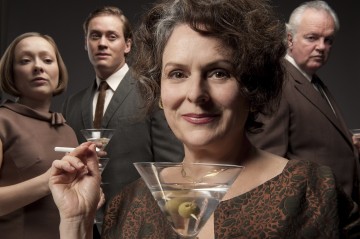
I have spent a week struggling with my reaction to the current production of Edward Albee's seminal American play Who's Afraid of Virginia Woolf, an Arts Club/Blackbird Theatre co-production running on the Granville Island Stage until March 12th.
One one level, it's brilliant. The actors display a startling endurance and range, and the performances have "size" that would make the most jaded acting critic proud. These are veteran actors, handling difficult and demanding material, a degree of acting virtuosity that is the emotional equivalent of a troupe of Cirque Du Soleil acrobats tying themselves in pretzels.
On the other hand, the play is a physically and emotionally exhausting grind. The characters spend the entirety of the three and a quarter hours of the play in various cruel games with each other, alternately building castles of self-delusion and cracking them apart in the most vicious way. Although I believe Albee's intention is to get his audience to question the comfort of their illusions, mostly I simply felt relieved to escape the theatre.
Martha and George are a long-married couple, whose love is expressed in the witty and rancorous barbs that they throw at each other, often with smiles on their faces. The first act begins in the wee hours of the morning, as they return from a faculty party thrown by Martha's father, the Dean of the College where George is an assistant professor. We soon discover that Martha has invited "guests," fresh meat from the Biology department and his wife. Over the course of three acts Martha and George vie to top each other in inventing new ways to belittle and humiliate each other in front of the guests, in a way that moves from mock-genial banter in Act One to full out war in Act Three.
Gabrielle Rose tears up the stage as Martha, a tiger trapped in the body of an aging, childless faculty wife whose life ambitions appear to have bottomed out in her marriage to George. Her Martha struts, brays, growls, purrs and roars her way across the stage with an incredible, visceral energy and full vivid physical life. Kevin McNulty's George fights a guerilla battle against his tiger of a wife, avoiding, deflecting, pontificating and deriding, alternately treating her like a willful child and playing the wounded sad sack that she would make him be. It's a beautiful pas-de-deux, and when the two of them are on the play snaps between laugh-out-loud comedy and vivid pathos with disorienting rapidity. Craig Erikson's Nick is a confident foil to his rampaging hosts, and his ambitious boxing-champion-cum-young-
And with all that, with these gifted performers bringing so much to the stage, somehow the play still doesn't quite sizzle. Some of George's "explosions" fall painfully flat, with McNulty pushing for a deep wounded sensitivity that's at odds with the rest of his characterization. Gabrielle Rose's wild and brilliantly sized Martha goes so far into theatricality that by Act Three she's almost performing in a different style than the three characters she's sharing the stage with, an absurd character in an almost-realist world. Nick's vocal style is sometimes a bit affected. But over the course of three hours, eight times a week? There will always be some up-and-down. I expect that when I go to the theatre. It's the play itself somehow that manages to take the audience on an emotional rollercoaster without actually going anywhere. It may be that the central premise of the play, that basic titular question that can be expressed as "who's afraid of living life without false illusions," is simply answered too early in this production. When George asks an exhausted Martha at the end of the play "Who's afraid of Virginia Woolf" and she says "I am, George... I am" there is no discovery for the audience. We already know that the characters are wrapped up in their own illusions, that they need them as much as they fight them, and we just want to put them to bed and get out of there.
It may also be that this play, while incendiary for it's time, simply reads differently to a modern audience. I wonder at the difference between the first 1962 audience's experience of seeing this play, and my own conflicted reaction. As a scathing indictment of the terrible things that can be concealed beneath a polite exterior, as an expose on how horrible our neighbours can be to each other when we're not watching, it may have shocked those audiences and left them reconsidering their own illusions. I'm already quite aware of how horrible people can be to each other, and three hours of expose just left me feeling wrung out.
Go see Who's Afraid of Virginia Woolf if you want a real education in what it takes to be a gifted actor, or just for the experience of seeing this Great American Play done and done well. But know what you're getting into. And don't say I didn't warn you.