


The Legend of White Woman Creek - A Heartbreaking Story
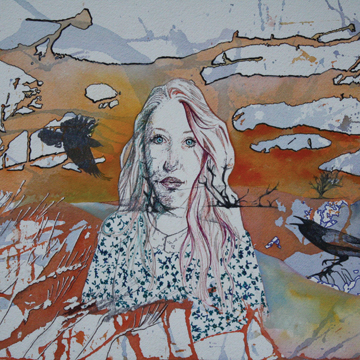
"The Legend of White Woman Creek" has its roots in the brutal conquest of the American West. Reality was different than the triumphal narrative of brave pioneers, bound together with love of family and God, who fought the savage natives and usually won. But we know now that "Little House on the Prairie" and Hollywood Westerns are not completely true.
History is written by the victors, it's said, but other versions linger in the collective unconscious too. A quick Google search for "White Woman Creek" brings up two conflicting narratives of how the creek got its name, and neither exactly matches the version that Katie Hartman brings to life in this production. So what really happened? We can't know, but with "The Legend of White Woman Creek", we do get a very interesting and musical take on this longstanding legend.
Anna Morgan Faber is a woman who has taken a brave and probably foolhardy risk -- to leave West Virginia where she is a schoolteacher and marry her brother's comrade-in-arms during the Civil War (on the Union side), Heinrich Faber, who has a farm in Kansas. The year is 1867, and USA expansionist ideology is urging both men and women (white, of course) to go west and settle these wild lands.
Katie Hartman conjures the ghost of Anna Morgan Faber to tell her story, using an interesting theatrical device (see it for yourself!). Soon, Anna wears her simple gown, and picks up a guitar, and starts playing and singing her heartbreaking story.
I read that the style of these songs matches American Western folk songs. Certainly, there is at least one very familiar tune that you will likely recognize, even if it's been taken down-tempo and made more mournful. I have some interest in the genre of 19th-century American folk music, and thus I found it interesting to see what Hartman (and her partner Nick Ryan, who together form The Coldharts) did with this music. I found the style somewhat reminiscent of how Joan Baez sings traditional folk ballads. (And at the end of the play, The Coldharts offer a discount on an album download.)
The musical style is interesting and enjoyable, and the story is compelling. Anna is a woman who is often left without any choices at all, and she suffers horribly for that. Kansas in the late 1860s is a place where battles between white settlers and the Cheyenne inhabitants are a bitter reality, with the settlers feeling free to steal from local villages to get what they want. Because of circumstances, Anna ends up in a situation that alienates her from everything she has known. Anna is filled with self-recrimination for so many things for which she is not to blame. The ending is violent and tragic.
The landscape of Kansas, at the east of the Great Plains, is the unseen backdrop of this play. When she first moves west, Anna lives in a sod house, in misery.
You don't have to research this play on Google before going, as everything you need to know is given to you in the performance. Anna and her life experiences are what matters in that context.
But, if you are a nerd and really want to know more, I recommend research, and I could not help looking up stuff afterwards. For example, Anna is born in West Virginia, back when it was part of Virginia. But why did these states separate -- I had forgotten it was because West Virginia wanted to be on the Union side, whereas Virginia, of course, was the centre of the Confederacy.
Although this play was first held in the courtyard of the Firehall, it has now been moved upstairs, as the surrounding neighbourhood is a rather noisy backdrop. The staging is simple and effective.
The play hit so many of my personal interests such as American history, American folk songs, the position of women in America, and historical relationships between whites and Native Americans, that it's hard for me to be objective. If you like a story well-told and well-sung, I think you will like this play.