


If Robots Could Choreograph...:Édouard Lock's "New Work."
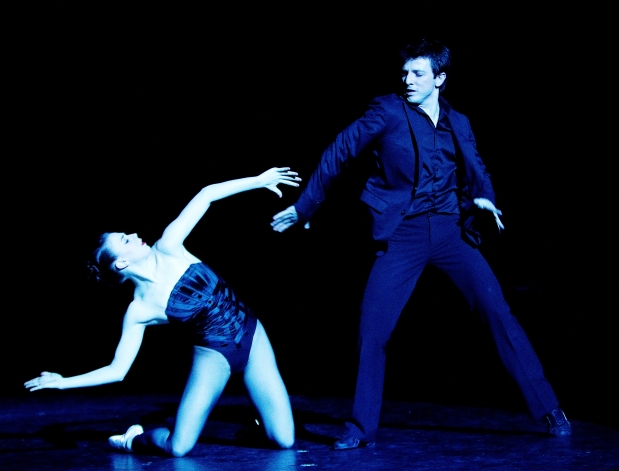
Can a choreography be at once an orgiastic celebration of the human body in motion and an utterly clinical, soulless exhibit of dance?
Édouard Lock’s “New Work”, danced by La La La Human Steps, presented on January 21st and 22nd at the Centre in Vancouver for Performing Arts, lays claim to technically excellent dance, almost 90 minutes of vigorous choreography, and enough amped up energy to power a small nation. It is, however, like so much of Lock’s work, devoid of emotion or narrative. I imagine that if robots could choreograph, this show is what they might produce.
The entire piece is danced in a harsh light that provides spots to emphasize the dancers’ muscularity, but do nothing to reveal their expressions, either facial or gestural, in any way that would humanize them. Thus a style that would work well as a special effect, is drawn out throughout the performance, creating an atmosphere that is inaccessible both in terms of choreography and ambience.
The musical score makes use of live musicians playing sections from the operatic versions of the tragic love stories Dido and Aeneas by Purcell and Orpheus and Eurydice by Gluck. The music is heartfelt and has, I’m afraid, much more depth than the dance. As much as these tragic love stories are heart-rending and despairing, “New Work” has a chilliness that can’t be shaken, and the contrast between the warmth of the music and the cool of the dance is both confusing and uncomfortable. “New Work”, for all its emotional emptiness could just have easily, and more understandably been choreographed to some industrial score. Again, I have an image in my imagination of computer programmers inventing a program that could choreograph “love”: Lock’s dancers are superbly talented and their immense energy carries them through the unrelenting choreography, but the choreography itself allows not a flicker of emotion to emerge, making me wonder about the wisdom of using the two operatic pieces at all.
Seeing “New Work”, I am also left to question Lock’s loyalty to the pointe shoe. The tempo of his work is so relentless, and the choreography so precise, that the women on pointe appear mechanized and harsh, which only furthers the clinical and robotic mood that is created.
In the end, the pertly named “New Work” struck me, as many of Lock’s pieces have, as being so absent of any human emotion, and so unwilling to connect with its audience, that I found it verging on insincere. Its throbbing pace robbed it of momentum or development, and its style choices robbed it of depth, leaving me feeling as if I’d just seen a group of marvelous technicians perform dance as though it is a form of physics and not a form of passion.