


La Cages Aux Folles: two plank perspectives
Kirstie: La Cage Aux Folles the musical premiered on Broadway in 1983. It is based on the even earlier (1973) play of the same name. Watching it on the eve of 2012, I think it’s fair to say that while the theme of love trumping prejudice is timeless, the musical’s treatment of gender-roles, queer families, and homophobia feels so dated that it’s practically geriatric. This is not to say that the story isn't entertaining or meaningful, but that enough has changed since 1983 that I think that the sharp dichotomy bewteen the queers and the conservatives felt clunky and unsubtle by todays standards (or at least by my own).
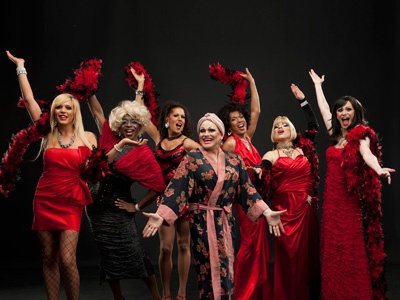
George and Albin are a gay couple and co-owners of La Cages Aux Folles drag club, where Albin performs as Lady Zaza in the company of a chorus of lovely drag queens known as the Cagelles. Together, George and Albin have raised George’s biological son, Jean-Michel. The drama is launched when 24-year-old Jean-Michel returns home to inform his parents that he is engaged to a girl, and not just any girl, but to the daughter of the ultra-right-wing leader of the “Tradition, Family, and Morality Party.” Desperate to win her hand, Jean-Michel shoves his parents into the closet for the duration of the Dindon family’s impending visit: George is told to say he is a diplomat and Albin, considered too “unconventional” to pass muster, is expected to either absent himself or -- when that plan falls through -- to perform as the ridiculously hypermasculine “Uncle Al.” Of course this is a comedy of errors, and the plan goes wildly awry. Albin wins the Dindon’s hearts by remaining true to his feminine nature, but their admiration lasts only as long as they think he is a biological woman.
I found it difficult to sit through the set-up of this plot in Act I. I was horrified at Jean-Michel’s gross sense of entitlement. He doesn’t simply ask his parents to put away one or two pieces of provocative decor, but to hide their entire relationship. And he expects Albin to simply vanish, because Albin’s mannerisms and personality are obviously too queer. Even worse, Georges hardly protests, because he implicitly agrees. The painfulness of this moment is important to the play, but I badly wanted to see Albin and Georges stand up for themselves, and more than that I wanted Jean-Michel to be even a little bit ashamed of his request.
Now the whole point of the story is to represent the clash between a gay family and a homophobic one, and without the concealed and mistaken identities, there would be no drama. The take-home messages are obvious: Albin’s performance of drag is more authentic than his attempts at conventional masculinity; the love and acceptance that bonds the family of La Cage Aux Folles is as authentic as any hetronormative “traditional” family; and those who preach intolerance will get their come-uppence when they find themselves reliant on the generosity of those whom they denigrate.
La Cage Aux Folles was specifically written to appeal to a "mainstream" and "middle-class" audience, a fact which explains something about the neat and tidy narrative. And intolerance towards gay families has not been eradicated, so there’s plenty of reason to keep telling tales reiterating the message that everyone has a right to love and to build family and community. But the characters of La Cage Aux Folles are painted with strokes so broad they are practically four-lane highways: Jean-Michel is blindingly oblivious to his own selfishness, the Dindons are cartoon villains, and Georges is utterly spineless. Only Albin is a full character.
Which brings me to the subject of the masculine-feminine dynamic between Georges and Albin that Danielle mentions. On the one hand, I can see these two men as representing one possible romantic arrangement out of a myriad of ways that a couple could embody traits that have been traditionally called masculine and feminine. On the other hand, I would much prefer to experience a story with a more complex layering of possible roles. Far more than watching Georges and Albin play Pater and Mater, I enjoyed watching the Cagelles. Although their characters are all uniformly presented as drag queens (throughout the show I kept thinking about some of the excellent transgendered stories I’ve seen recently, like the 2011 film Gun Hill Road, and wondering where trans. considerations fit into the world of La Cages Aux Folles) they represented a wider spectrum of types: they were tall, stocky, slender, muscular, seductive, innocent, and aggressive, not to mention multi-racial. It was an utter relief when the cagelles burst from the wings onto the stage, helping to blow Albin’s cover, and returning the club to a state of delightful expressive mania.
Of course this is the point: after the fierce repression and discomfort of watching our heroes try to perform for the Dindon’s the audience breaths a collective sigh of relief when the charade is over and everyone at La Cage can once again let their freak flag fly.
Danielle and I went to see La Cage Aux Folles on a Monday night in early December. The house was remarkably full for a Monday, audience laughter was so reliable after the punch lines that it could have been cued, and the show received a standing ovation. Part of this is because the tale is predictable, but it also speaks to the way that the story told by La Cages Aux Folles is now a classic. And in many ways this pleases me. I like that I can go to a major theatre and see a show about gay club owners getting the best of homophobes because love is stronger than fear, and watch it get a standing ovation. And I also like that I can watch this show and feel that it is by far too safe, too easy a win, because there are so many other stories that can and should and frequently are being told about sexuality and gender and family.
My biggest question about this incarnation of La Cage Aux Folles is why, when there are so many possible angles that one can take on this story that would resonate today, there was no effort to update it? There are opportunities, through set and costume and staging, to gesture toward contemporary stories even while adhering to an original script (this happens all the time with Shakespeare). It’s true that there’s lots going on already: we see Albin in several incarnations -- his stage persona Zaza, his non-theatrical-but-still-dramatic self in the streets with George, his attempt to become macho Uncle Al, and his charming expression of himself in the role of wife-and-mother. But I can’t help but feel like the other characters needed to be destabilized a lot more. What about Jean-Michel? How are his kakis, sweater-sets, and youthful arrogance also a finely crafted self-expressive performance? And the stage dressings seemed like a study in leaden extremes: George and Albin’s livingroom is transformed from Greek nudes to gold crosses. Surely there was room there for a little nod or a wink to some modern iconography or a little social satire?
I do love the end of the show, when the Dindon family is forced to dress in drag to escape the paparazzi. The kind of highlighting-of-performance that I’m thinking of does happen then: Anne, the daughter, exits the club dressed as the “Last Known Virgin” and both her parents are given stage names that somehow reflect their “normal” characters. And earlier in the story Albin does tease George for imagining that George’s own mannerisms are unquestionably masculine. In these ways I think all of the characters are shown to be performing their own versions of their genders and sexualities. But I think that more could be done with this story to set it in relation to present-day themes and social codes. I know it’s just a musical and it’s on the stage to please and entertain us before the Christmas holiday. But still, when I go to the theatre I want to be challenged just a little bit more to rethink and reimagine what is possible in the world that I live in.
I will say though, that as we launch into this most traditional of seasons, it was refreshing to think about La Cage Aux Folles representing another holiday tradition. ‘Tis the time of year when consumer culture saturates us with every old chestnut from Oh Holy Night to I Saw Mommy Kissing Santa Claus, which makes me want to find that velvet-covered, glitter-encrusted refuge for misfits and not come out until it’s all over.
Danielle: In the spirit of the play, I want to pretend. Pretend that I don’t know anything about theatre, care about acting, set or production standards and talk about how this production made me feel. I’ll get to the critical dissemination later.
I want to talk about gender roles and taboos and inverses and what we think is ok and why and how we dress taboo things up to look like what’s acceptable. I don’t have any answers on this. I barely have any well-formed opinions, but La Cage Aux Folles got me thinking and I want to explore this....
For example the whole displacement thing. I am sickened by the exaggerated male/female gender roles in a same sex relationship because it’s all so obvious. But really, how different are they from Torvald and Nora in a Dolls House “role”-wise? And how bigoted am I for only thinking of these things now?...
This play, dated and obvious as it was, got me thinking. About my own sexuality and about my assumptions and beliefs. Perhaps because it was so simple. Not that my soul-searching has much place in a review so that’s enough about that. But it’s important that theatre makes us think, challenges our world view, so I wanted to mention it.
OK, so to the theatre craft stuff: The little girl in me DELIGHTED in the set. It was fabulously kitsch. The sparkles on the cardboard waves were perfect. And the tableau's and costumes and set decoration were just perfect in my opinion. I felt like I was stuck somewhere between Vegas and a Christmas pantomime.
The script was also well done. It’s sad that I usually only notice clever lines when the timing or the tone is off and there were a few that were fumbled I felt, but all in all delivery of punchlines was consistent and there were some great lines. None of which I can remember.
I don’t know if it was just me, but I felt the sound was a little off. The mics were a tad too sensitive, discouraging actors to really fill the space (or perhaps I shouldn’t blame that on the technology) and I was aware of the mics. Which I think you never should be. That said, I do have a sensitive ear and probably no-one else noticed?...
All the actors were pretty solid, I thought. David Marr had not quite enough personality for me at the beginning, I didn’t believe that he filled the space as the MC. Although in “real life” scenes the choice worked as the “sensible” contrast to Albin. And I felt that Greg Armstrong-Morris excelled himself as Albin. There is a huge difference between a stagey character and a stagey performance. Most actors get away with muddying the edges, but I think Marr nailed that subltey. His was the only character I truly believed, through and through. Over-the-top-characters are tough and it’s hard to find an actor to carry the fabulously overdone, the superficial and manipulative and the quiet and vulnerable with such finesse. Ironic that the most extravagant and “false” of the characters was the only one that moved me. But that says something about truth in make-believe doesn’t it?