


Scorched
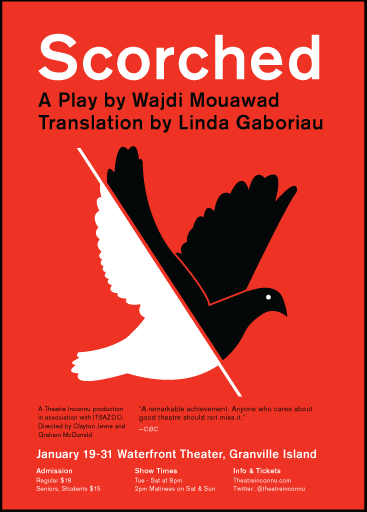
Written by Lebanese-born Quebecois playwright Wajdi Mouawad, Scorched is a play of epic proportions that explores the roots of cyclical violence.
At its heart is Nawal, a civil-war survivor from an un-named Middle Eastern county, who lives her later years in Montreal with her twin children, Janine and Simon.
The play opens with Nawal's death, which has left a mystery in its wake: Janine and Simon have each been charged to deliver a sealed envelope to their father and brother respectively – family members that they did not know existed, having been raised to believe that that their father had died in the war and that they were their parents only children. As they travel back to their mother's home village, the drama that unfolds reveals secrets about their birth that she had all but carried to her grave.
The plotting of Scorched is intricate and the vagaries of war lead to constant twists. What seems, at first, like a simple tale of star-crossed lovers becomes the story of women escaping their narrow lot in life, which in turn becomes a harrowing tale of one war horror after another. Nawal's early life, revealed in the lyrical language of a parable, is intercut with the stories of Janine and Simon unraveling her history.
The play's message is articulated by characters in many different ways: a violent life lead in the name of revenge will warp the human soul and sews the seeds for even greater violence. Nawal, with her commitment to personal enlightenment, is a single voice of reason and compassion in a cacophony of suffering. Her individual struggle to maintain humanity and find justice raises larger questions about how a nation can repair itself after a brutal war that pits neighbors and even families against each other.
Stylistically, Scorched is a strange beast. Mouawad's script, as translated by Linda Gaboriau, is poetic and surreal. Metaphors for death and war abound – from blood-drained animal corpses to bloodthirsty wolves. This lyricism is frequently moving, but just as often it plunges the play headlong into melodrama. And in a narrative where genuine horrors occur more than once, it is sometimes diffcult to see why the playwright so often chooses figures of speech that say less about war than the facts do. The cast works hard to bring their dialogue to life, but much of the writing seems meant for the page and not for the ear, and comes off sounding quoted, wordy, and heavy. Their efforts often highlight the fact that, for better or for worse, this is a literary play with exceedingly dense language.
Theatre Inconnue makes a brave effort to animate some dark and painful subject matter. Casey Austen, playing Nawal at various stages of life, has the lion's share of the work. She is best as the adult Nawal – luminous, controlled, and intelligent. Her performance as young Nawal is impassioned, but the character's dialogue at this point is so overwrought that it is difficult to see the performance for the words. Jason Stevens plays the villain's role with a swagger and a chilling lack of remorse. He is not burdened with driving the plot, and his brief appearances as a war criminal brought to trial are deeply affecting.
Running at three hours plus intermission, this Governor-General's-Award-Winning play might have benefited from some thoughtful editing in its earlier incarnations, to cut out repetition and set the essential stories in their best light. Scorched does have real insight into the darker side of human nature, but convolutions in the plot and overwriting significantly lessen its dramatic impact.
Scorched by Wajdi Mouawad, trans. Linda Gaboriau, presented by Theatre Inconnu & ITSAZOO Prods. It runs at Waterfront Theatre until January 31st. For more information scorch yourself here.